



10 Sep How Prolotherapy Supports the Body’s Natural Repair Process
How Prolotherapy Supports the Body’s Natural Repair Process
Persistent joint or soft tissue pain can have more than one cause. Prolotherapy is an injection based treatment that may be considered when a clinician believes a ligament, tendon, or joint structure is contributing to ongoing pain or instability.Lorem ipsum dolor sit amet, consectetur adipiscing elit. Ut elit tellus, luctus nec ullamcorper mattis, pulvinar dapibus leo.
What Prolotherapy Is
Prolotherapy is a nonsurgical injection treatment used for selected musculoskeletal conditions. A clinician injects a solution, most commonly concentrated dextrose, into or near the structure believed to be contributing to pain.
The solution is intended to stimulate a localized biological response. The proposed goal is to support repair activity in irritated or weakened connective tissue. The exact mechanism and the extent of tissue regeneration are still being studied, so prolotherapy should not be described as a guaranteed way to rebuild damaged tissue.
What the Evidence Shows
Clinical studies suggest that dextrose prolotherapy may improve pain and function for some people with knee osteoarthritis and certain tendon or ligament problems. Evidence is not equally strong for every condition, and individual outcomes vary.
A complete evaluation matters because similar symptoms can come from different tissues or from problems that require a different treatment. Prolotherapy may be one part of a broader plan that includes rehabilitation, activity changes, medication, platelet rich plasma therapy, or surgical evaluation.
Conditions That May Be Considered
After an examination and appropriate imaging, a clinician may discuss prolotherapy for selected cases involving:
- Osteoarthritis related joint pain
- Chronic ligament sprains or joint instability
- Tendon injuries and tendinopathy
- Persistent knee, hip, shoulder, ankle, or elbow pain
- Tennis elbow or golfer’s elbow
- Lingering sports or overuse injuries
- Certain cases of neck or lower back pain
A diagnosis is more useful than a symptom list. The clinician must first determine which structure is involved and whether injection treatment is appropriate.

Why Ultrasound Guidance Matters
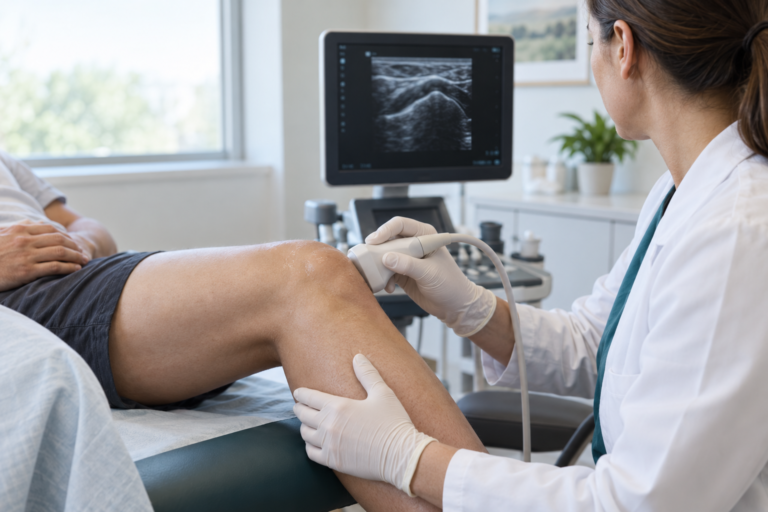
At Advanced Rejuvenation, Dr. Alex Smithers uses real time ultrasound to evaluate the joint and surrounding soft tissues and to guide treatment. Ultrasound can help the clinician visualize the needle and place the solution in the intended area while accounting for nearby structures.
Imaging can also provide information that changes the treatment plan. Depending on the findings, rehabilitation, platelet rich plasma therapy, another injection approach, or a surgical consultation may be more appropriate.
What to Expect
Prolotherapy is generally performed as an outpatient procedure. Temporary soreness, stiffness, swelling, or bruising can occur after an injection. Less common risks can include bleeding, infection, allergic reaction, or injury to a nearby nerve or tissue. Your clinician should review risks that apply to the treatment area and your health history before the procedure.
The number and timing of treatments depend on the diagnosis, the tissue being treated, the severity of the problem, and the patient’s response. When improvement occurs, it often develops over several weeks rather than immediately.
Is Prolotherapy Right for You
Prolotherapy is not appropriate for every source of pain and does not guarantee that surgery or other treatment can be avoided. It may be worth discussing when pain has continued despite conservative care and an evaluation identifies a potentially treatable ligament, tendon, or joint structure.
Schedule a consultation with Dr. Alex Smithers at 941 444 6336
Sorry, the comment form is closed at this time.